Complimenting Garden Accessories With Your Art
A lantern by the seating area, a patterned outdoor rug, a row of planters in the right finish - these details already say something about your garden. The question is whether your wall art supports that story or competes with it. Complimenting the garden accessories with your art is less about matching everything perfectly and more about creating a space that feels considered, balanced and genuinely enjoyable to spend time in.
Outdoor styling works best when the art feels like part of the setting rather than an afterthought. In practical terms, that means looking at shape, colour, scale and material finish across the whole space. A beautiful piece of outdoor wall art can tie together furniture, planting and decorative accessories, but only if it has been chosen with the garden in mind.
Why complimenting the garden accessories with your art changes the whole space
Most gardens already have a visual language. It might be clean and architectural, soft and botanical, or eclectic and full of personality. Accessories often establish that language first. Cushions, pots, lanterns, screens, outdoor mirrors and table styling all contribute to the overall mood.
Art brings focus. It gives the eye somewhere to land and can turn a plain fence, courtyard wall or patio corner into a finished feature. When the artwork echoes the accessories without copying them too closely, the result feels elevated. When it clashes in scale or tone, even expensive styling can look disjointed.
This is where many outdoor spaces go wrong. People spend time choosing furniture and plants, then add art at the end with no real connection to what is already there. The fix is usually simple. Read the accessories first, then use art to sharpen the design direction.
Start with the accessories already in place
Before choosing a piece, look at what your garden accessories are telling you. Are your planters dark and contemporary, or textured and earthy? Do your cushions bring in muted neutrals, tropical greens or bold terracotta? Is your lighting polished and modern, or relaxed and rustic?
These choices reveal the style lane your art should sit within. A modern patio with black-framed furniture and structured planting often suits abstract work, graphic shapes or monochrome photography. A softer garden with woven accessories, natural timber and layered greenery may suit botanical subjects, faded vintage-inspired prints or artwork with warm, organic tones.
That does not mean every item must match. In fact, a space with too much coordination can feel flat. The goal is connection, not uniformity. If your accessories are understated, art can take more of a lead. If your accessories are already busy with pattern and colour, the artwork may need to be calmer.
Look for repeated cues
The easiest way to make art feel intentional is to repeat one or two existing elements. That could be a shape, such as arches, circles or clean linear forms. It could be a colour that appears in plant pots, cushions or outdoor tableware. It could even be a mood - crisp and minimal, romantic and weathered, playful and expressive.
Once you identify those cues, selecting art becomes more precise. You are no longer shopping for something simply because it looks good on its own. You are choosing something that improves the whole composition.
Colour matters, but balance matters more
Colour is usually the first thing people think about when pairing art with garden accessories, and rightly so. It has an immediate impact. But the best results come from balancing colour rather than forcing a direct match.
If your garden accessories lean neutral - stone, sand, charcoal, black, cream - art can introduce depth without disrupting the scheme. Deep greens, soft blues, rust tones and off-whites tend to work particularly well outdoors because they feel connected to the natural setting while still adding design interest.
If your accessories already feature strong colour, choose one or two tones from that palette and let the artwork build on them. A print with terracotta, olive and soft blush can sit beautifully with clay pots and warm-toned cushions. A cooler scheme with grey planters and blue textiles may benefit from art with slate, indigo and crisp white.
There is also value in contrast. A bright artwork against a muted entertaining area can lift the entire space. A darker, moodier piece can ground a sunny corner filled with pale furniture. It depends on what role you want the art to play - supporting feature or focal point.
Scale is often the difference between stylish and underwhelming
Even a well-chosen design can look wrong if the size is off. Small artwork on a large fence tends to disappear. Oversized pieces in compact courtyards can feel crowded. When complimenting garden accessories with your art, scale needs to relate not only to the wall but also to nearby objects.
Look at the visual weight of your accessories. A pair of substantial planters, a wide outdoor sofa or a large dining set can handle a more commanding artwork. Slim bistro furniture, delicate lanterns and smaller decorative accents usually suit a lighter visual approach.
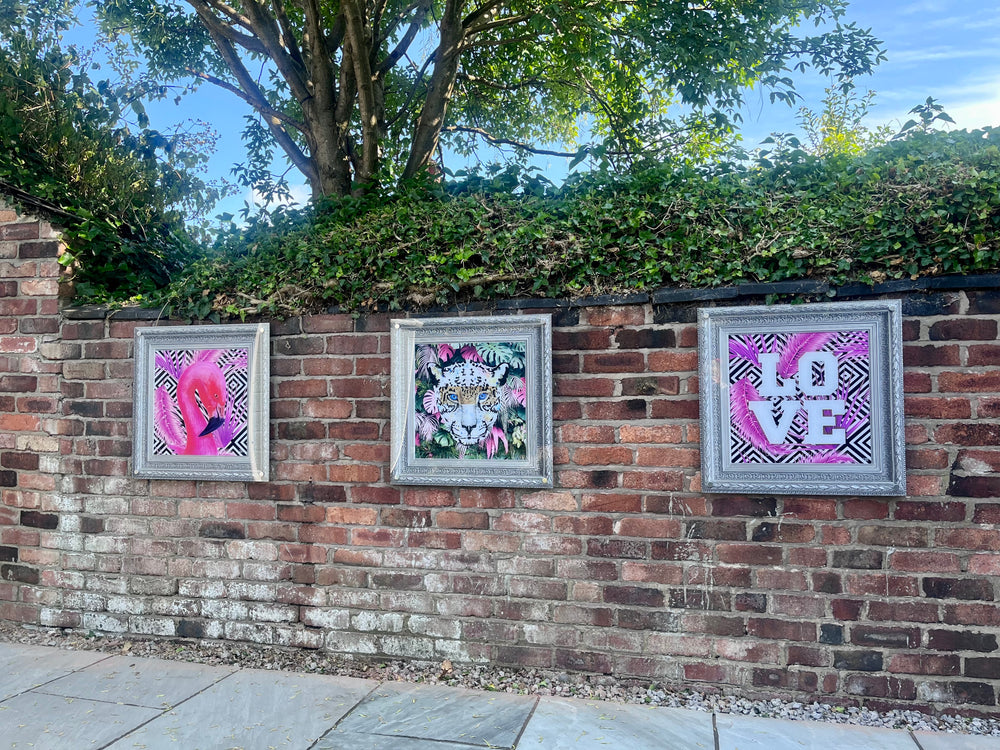
If you are styling above a bench or console, the art should feel anchored by what sits below it. If it is going on a long boundary wall, one statement piece may work, but a carefully spaced arrangement can be even better. Large-scale outdoor art often brings the strongest transformation because it helps the garden feel designed rather than simply decorated.
Think in zones
Many gardens now function as outdoor rooms. You may have a dining zone, a lounging area and a quiet corner for morning coffee. Art can reinforce those zones and help accessories feel more curated within each one.
A vibrant contemporary print might energise the dining area where entertaining happens. Something calmer and more textural can soften a reading nook. In a courtyard, one striking panel can create a natural centre and help the surrounding planters and lighting feel purposeful.
Texture and finish deserve more attention
Outdoor spaces naturally contain more texture than interiors. Brick, render, timber, stone, foliage and fabric all sit together, often in changing light. Your art should work with that richness rather than fighting it.
This is one reason purpose-made outdoor wall art makes such a difference. It is designed to hold its visual clarity in exterior conditions, and the finish often gives colours a clean, polished presence against natural surfaces. That contrast can be especially effective on garden walls that need definition.
If your accessories are heavily textured - wicker, terracotta, rattan, rough ceramics - artwork with a sharper, cleaner finish can provide balance. If the space already feels sleek, art with softer imagery or painterly movement can stop it feeling too hard. The right mix creates depth.
Style pairings that work naturally
Some pairings are especially effective because they share a design logic. Contemporary furniture, geometric planters and architectural planting often sit comfortably with abstract or modern prints. Vintage-style lanterns, weathered pots and layered textiles can suit nostalgic florals or faded poster-inspired pieces. Boho accessories, patterned cushions and relaxed seating usually work well with art that has warmth, movement and a slightly eclectic edge.
Street art can look fantastic in urban courtyards where the accessories are pared back and the art is allowed to take the lead. Botanical artwork is often the easiest choice for lush gardens, but it works best when it adds structure or contrast rather than simply repeating what is already in the borders. Equine or limited edition statement pieces can bring a more personal, collected feel, especially in spaces where the accessories are understated.
The point is not to follow a formula. It is to recognise when a style pairing feels effortless.
Performance matters as much as appearance
There is no design win in choosing artwork that looks right in week one and tired by season two. Outdoor spaces are exposed to sun, rain and temperature shifts, so materials matter. When you invest in art for the garden, it should be made for exterior living rather than treated like indoor decor that has been moved outside.
That practical confidence changes how you style the space. You can place statement art near patios, fence lines and entertaining areas knowing it has been created to cope with real conditions. For homeowners who want decorative impact without constant maintenance, that is not a small detail - it is part of the appeal.
At YARDART UK, this is exactly where outdoor styling becomes easier. When the artwork is weatherproof, UV-resistant and straightforward to install, you can focus on what it adds visually instead of worrying about whether it belongs outdoors at all.
When not to match too closely
There is a trade-off in every design choice. If the artwork mirrors your accessories too exactly, the garden can feel predictable. If it ignores them completely, the scheme can feel unresolved.
Usually, the best answer sits in the middle. Let your accessories set the tone, then choose art that adds either contrast, scale or a stronger focal point. A restrained patio often benefits from bolder art. A highly styled garden may need a simpler piece to create calm.
If you are unsure, strip the decision back to three questions. Does the artwork echo at least one element already in the space? Does it bring something new? And will it still feel right in winter, when planting is less generous and the accessories carry more visual weight?
A well-styled garden does not rely on flowers alone to make an impression. When your art compliments the accessories around it, the whole space feels more complete - not just decorated for the season, but designed for outdoor living.


Leave a comment